

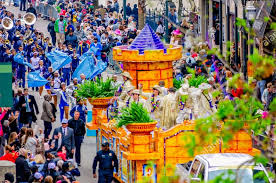
Carnival is here! In our last blog post, we dug into how the ways New Orleans celebrates this special season can be traced back thousands of years to ancient Europe.
We learned why we have these traditions leading up to Mardi Gras, but these traditions aren’t ours alone. While we are celebrating the Carnival season by wearing colorful costumes, eating and drinking in excess, and parading in the streets, cultures around the world are doing the same thing.
Many of these cultures put their own unique spin on the festivities. In this post, we’re going to explore a handful of them!
USA! USA! USA!
Before we span the globe, we should acknowledge that New Orleans isn’t the only Carnival celebration in the United States.
French explorers celebrated the first Fat Tuesday in North America on March 3, 1699 at a spot they appropriately christened Point du Mardi Gras. The site is on the west bank of the Mississippi River, 60 miles south of New Orleans, though future settlers would eventually spread Carnival across the Gulf Coast.
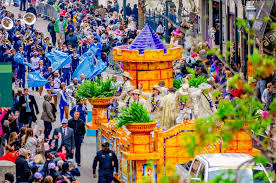
The first Carnival season parades in the New World took place in Mobile, Alabama. It is believed this began in 1711, when 16 members of the Société du Bœuf Gras (Society of the Fatted Ox) paraded on Mardi Gras while pushing a cart carrying a large papier-mâché cow’s head. Today, the city hosts more than 40 Carnival season parades.
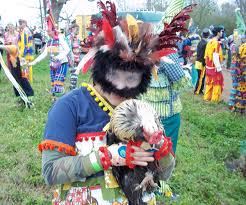
Meanwhile, in the small towns around Lafayette that make up Cajun Country, their Courir de Mardi Gras is entirely different. Masked participants in homemade costumes, many on horseback, go from house to house begging for ingredients to make a town gumbo. Most famously, this includes live chickens, which revelers chase through the mud.
But American Mardi Gras isn’t only left to the states along the Gulf coast. Polish communities in Rust Belt cities, for example, celebrate the day before Lent by eating doughnuts known as pączki. In the Hamtramck enclave of Detroit, an annual Pączki Day Parade takes place, while in Parma, Ohio, Rudy’s Strudel bakery hosts a celebration with special flavors of pączki, live polka music, pierogies, and mimosas.
The world’s biggest Carnival
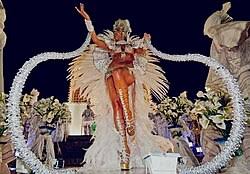
Rio de Janeiro has been celebrating Carnival since as early as the 16th century thanks to Catholic Portuguese colonizers. Those explorers could have never imagined what their festival would become. Today, more than two million people take to the streets every day during Rio’s lead-up to Mardi Gras.
The celebrations are highlighted by hundreds of street parties, as well as parades featuring more than 200 “samba schools.” These are more akin to community clubs than traditional schools, however, with thousands of neighbors engaging in a year-round effort to prepare elaborate floats, costumes, music, and choreographed dancing rooted in Afro-Brazilian culture.
A Winter Wonderland
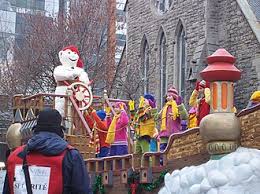
If Brazil sounds too warm for you, how about Mardi Gras in the snow at the Quebec Winter Carnival. Held since 1894, this is the largest winter festival in the Western Hemisphere, featuring French-Canadian culture, snow sculpture competitions, ice canoe races on the frozen St. Lawrence River, nighttime parades, live music, toboggans, an Ice Palace, fire pits, tons of food, and the festival’s iconic snowman mascot Bonhomme Carnaval.
Caribbean Carnival
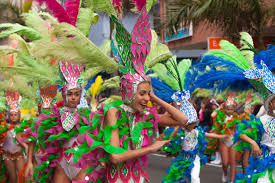
Trinidad, Anguilla, Grenada, and Barbados—these are just a handful of the Caribbean islands that celebrate what many describe as the most electrifying Carnival in the world.
Here, it is a tradition rooted in Black rebellion. In 18th century Trinidad, enslaved Africans were forbidden from participating in the masquerade balls of European colonizers. Instead, they created their own celebrations, defiantly crafting costumes of colorful feathers. They dance through the streets in parades to the Afro-Trinidadian sounds of calypso.
The joy of freedom is palpable in the thousands who still gather in the streets each Carnival, more than 200 years later.
Pancake Day
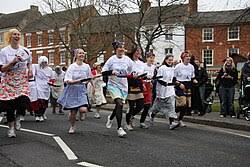
Cross the Atlantic Ocean for something completely different. In the United Kingdom and Ireland, the pre-Lenten meal of choice is a thin pancake topped with butter and lemon. (In Newfoundland, Canada, a tradition similar to our king cake involves a trinket hidden inside the pancakes for children.)
The day is often called “Pancake Day,” but is officially called Shrove Tuesday because the word “shrive” refers to the absolution before Lent that comes from the required confessions. Celebrations take place in communities throughout the country, often with “pancake races” where participants race while flipping pancakes in a frying pan. Some towns have continued the medieval tradition of chaotic “mob football” games involving many participants playing at once with very few rules.
Maslenitsa Festival
Countries like Russia, Belarus, and Ukraine trace their Carnival season feasts to pre-Christian Slavic people, according to Sharon Hudgins, a University of Maryland professor and author of T-Bone Whacks & Caviar Snacks: Cooking with Two Texans in Siberia & the Russian Far East. Their Maslenitsa is known as Butter Week or Crepe Week.
“Early Slavs hoped for the short, dark, cold days of the preceding months to be banished in favor of longer ones illuminated by sunlight,” she said.
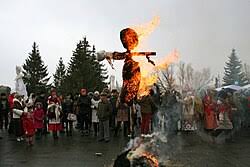
This was portrayed as a battle between winter spirits and the god of the sun. By indulging in gluttonous ritual foods, such as a circular treat similar to a pancake, Hudgins said they were doing their part to cheer on the sun’s return.
“It makes sense that in Russia they still eat a type of thin pancake called bliny this time of year,” Hudgins added, “and that you still find costumed merrymakers celebrating the sun and burning an effigy of the Old Witch of Winter.”
Today, while smaller town Maslenitsa festivals are still popular, hundreds of thousands of participants attend Maslenitsa in Moscow’s Red Square.
Renaissance splendor
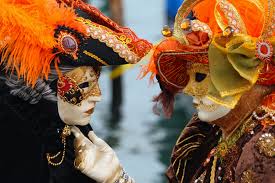
As we mentioned earlier, a major component of Carnival is the erasure of norms and social class. The Carnevale di Venezia in Venice, Italy does exactly this with two weeks of elaborate masks and ornate costumes at anonymous masquerade balls held in palaces and themed public celebrations in St. Mark’s Square. Costumed participants and spectators are everywhere transforming the city with water parades, music, and street theater.
Food fight!
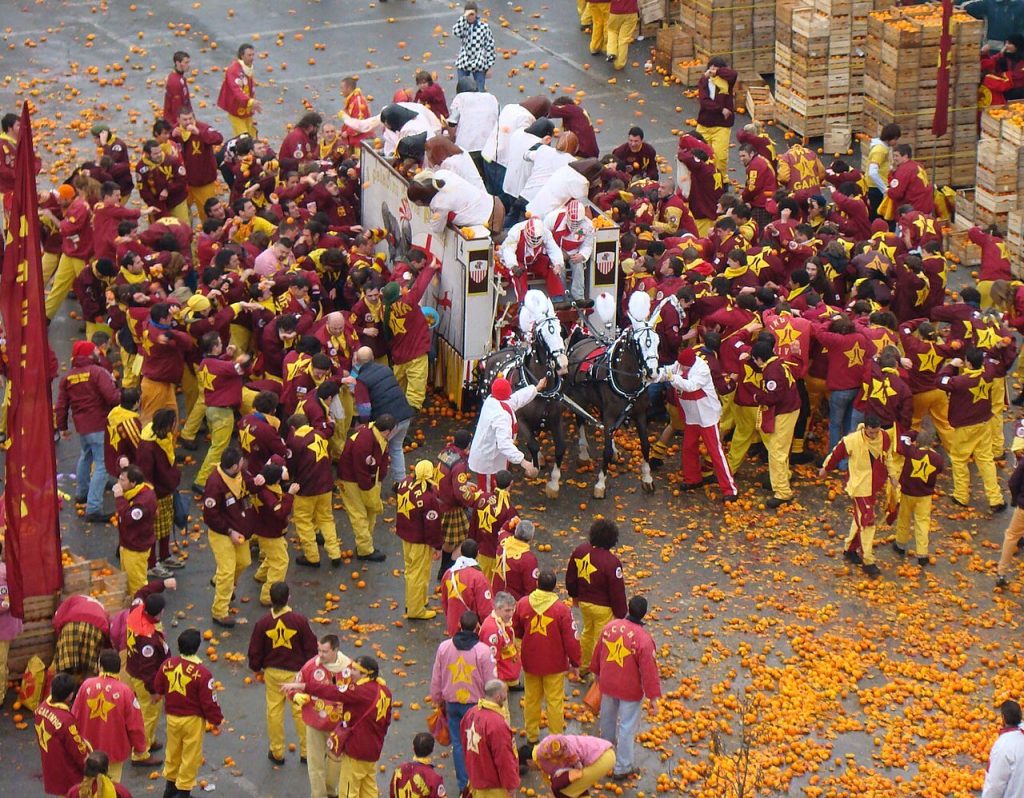
As you can see, many countries celebrate Mardi Gras in interesting ways. Perhaps none is more unique than the Carnival of Ivrea in Northern Italy. This is thanks to the “Battle of the Oranges.”
The origins of this celebration are dark. A local 12th century tyrant set his mind to raping a young commoner on her wedding night. The tyrant’s plan backfired, however, when the young lady decapitated him. Emboldened by her courage, and enraged by the tyrant’s disrespect, the town stormed and burned the palace.
Centuries later, these events are (very) loosely reenacted. Each year, a young girl plays the part of the defiant woman. The townspeople are armed with oranges (some say they represent the tyrant’s testicles, but who knows) and the citrus is thrown at those acting as the tyrant’s army. is split into two groups—the townspeople on foot and the
In addition to the Battle of the Oranges, Ivrea Carnival also includes a large bonfire, linking back to ancient celebrations about the end of winter and return of spring.
El Carnaval del Toro
Bœuf Gras parades have been a part of Carnival celebrations for centuries. Historically, butchers parade solemnly through the streets with an ox, cow, bull, or a sculpted representation of an animal.
We already mentioned that Mobile’s first Carnival parade was related to Bœuf Gras, and many New Orleanians are aware that one of Rex’s floats is that of a Bœuf Gras. All of this, of course, is meant to symbolize one final meal of meat before Lent.
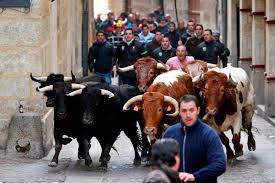
In Spain’s Ciudad Rodrigo, however, El Carnaval del Toro (Carnival of the Bull) uses their bovine in a different way. During their multi-day Carnival festival, celebrants run with bulls in the street and bull fights take place in medieval rings. Costumes signify a battle between good and evil, and brass bands and dances liven the atmosphere. On “Piñata Sunday” locals and visitors gather to eat one last round of the bull before it is forbidden.
A Jewish Carnival
Even other religions get in on the act. And that makes sense, given that it wasn’t only Christians facing food scarcity this time of year.
Purim is a Jewish holiday celebrating the storied salvation of the Jewish people from a plot to destroy them in ancient Persia.
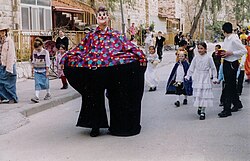
At first glance Purim’s story doesn’t appear related to Carnival. But how can it be a coincidence that this late-winter holiday also calls for colorful costumes, indulgent eating, and merrymaking. Purim is also the only holiday in which Jews are encouraged to get drunk, with holy text reading that followers should drink until they can’t tell the difference between the phrases “Blessed be Mordechai” (one of the story’s heroes) and “Cursed be Haman” (its villain).
Just the tip of the iceberg
And this is truly just a small handful of a world’s worth of Carnival celebrations. Festivals in Cologne, Germany and Viareggio, Italy are renowned across Europe, while a Carnival parade and wine festival in Goa—a Catholic region of India—shows how the traditions of Mardi Gras have continued to spread.
Iceland and Australia, Colombia and Japan — Carnival and Mardi Gras continue to grow.
Our New Orleans Carnival is unique, for sure, and there is a reason we attract more than a million visitors for it each year.
But—as we in New Orleans are fond of saying—”Everywhere else it’s just Tuesday?”
Not so fast!